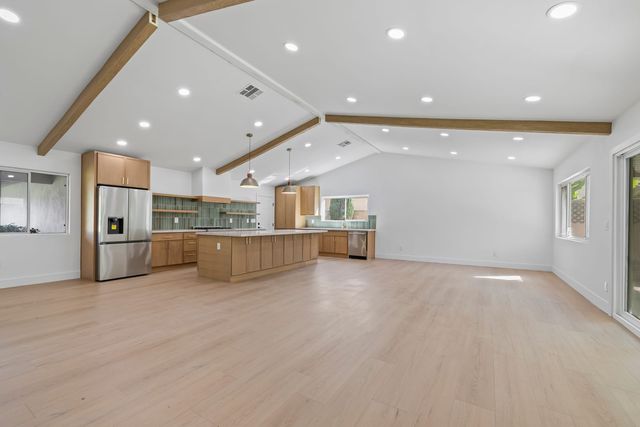
The sales comparison approach, the method that develops an opinion of value from the prices of similar homes that recently sold, adjusted for the differences buyers pay for, carries most Claremont house appraisals. The appraiser chooses closed sales a buyer of the subject would have weighed, verifies each one, lines them up beside the subject in a grid, adjusts each sale's price line by line, then weighs the adjusted results into one opinion. Below is that grid, left blank, row by row.
It is one of three approaches to value. The cost approach estimates what it would cost to build the improvements new, less depreciation, plus the land; the income approach converts the rent a property could earn into value. The three approaches to value on a Claremont home appraisal compares them.
Step 1: What question is the grid answering?
Before any sale is chosen, the scope of work, the type and extent of research and analysis, is set. It names the intended use, what the report will be used for, the intended users, the people entitled to rely on it, and the effective date, the date the opinion of value applies to. The house is then inspected and measured, because the subject column is filled from the house, not from a listing.
Step 2: Which market is the subject in?
Claremont is several markets inside ZIP code 91711: the Village and the pre-1940 blocks near the Colleges, the postwar tracts north of Foothill, the hillside in Claraboya and Padua Hills, Northeast Claremont by Stone Canyon Preserve, Arbol Verde, Base Line Road, and townhomes south of the 10. East of the Colleges, Mills Avenue and Claremont Boulevard lead into Montclair and Upland, in San Bernardino County.
For lender work, Fannie Mae's Selling Guide asks for neighborhood boundaries stated by north, south, east and west, and says the appraiser must not expand the neighborhood boundaries just to take in the sales chosen. Padua Hills property appraisal shows what happens when a pocket has very few sales, and appraising an Arbol Verde home shows a pocket where the house type decides the search.
Step 3: Which sales are collected and checked?
The Guide describes the approach as an analysis of comparable sales, contract sales and listings, and requires the appraiser to analyze all three. It requires the specific data source for each sale, such as deed records, to be stated, and data from a party with a financial interest in the transaction to be verified with a disinterested party. The appraiser must understand the conditions of sale, any financing concessions, and whether the sale was arm's length. The Guide adds that the report forms require the subject's three-year sales history and each comparable's twelve-month history.
Step 4: Which sales go in the grid?
A comparable sale is a closed sale of a property similar enough that a buyer of the subject would have weighed it. For lender assignments the Guide requires at least three closed comparables, says sales closed within the last 12 months should be used, and allows older ones when they are the best available and the report explains why. Contract sales and listings may support the analysis but do not count toward the three.
The blank grid, row by row
Examples never carry a real address, sale or value, so every cell is a dash. Line labels vary by report format. Fannie Mae and Freddie Mac reports submitted on or after November 2, 2026 use the redesigned URAR, which replaces forms such as the 1004; the new appraisal format in 2026 explains it.
Line itemSubjectComparable 1Comparable 2Comparable 3The sale
Pocket and proximity
-
-
-
-
Sale price
-
-
-
-
Data and verification source
-
-
-
-
Sale or financing concessions
-
-
-
-
Date of sale
-
-
-
-
Location and site
Location
-
-
-
-
Site area and topography
-
-
-
-
View
-
-
-
-
The house
Design and style
-
-
-
-
Quality of construction
-
-
-
-
Actual age
-
-
-
-
Condition
-
-
-
-
Room count
-
-
-
-
Gross living area
-
-
-
-
Below-grade area and finish
-
-
-
-
Garage
-
-
-
-
Porch, patio, pool
-
-
-
-
ADU or detached unit
-
-
-
-
The result
Net adjustment
-
-
-
-
Gross adjustment
-
-
-
-
Adjusted sale price
-
-
-
-
The sale
Concessions record seller-paid costs or unusual financing, and the date row is where a time adjustment for market movement between the sale date and the effective date is made, or explained as unnecessary. The Guide requires time adjustments, or the lack of them, to be supported by evidence.
Location and site
Location covers the setting buyers react to, such as a through corridor like Foothill Boulevard or a sale across the county line. Site covers size, shape and slope. View records what the main rooms look out on.
The house
Design, quality, age and condition describe the house as built and kept. Gross living area, the finished, heated living space above grade, is the measured figure, and below-grade area is reported on its own line. The garage, outdoor improvements and any ADU each get a row.
The result
Net adjustment is the sum of the pluses and minuses; gross adjustment is their total size regardless of direction.
Step 5: How is each adjustment made?
An adjustment is the amount a comparable's price is changed for a difference buyers react to. A better comparable is adjusted down, a weaker one up. The Guide requires adjustments to reflect the market's reaction to the difference, and names statistical analysis, modeling, paired sales or other accepted methods for market-condition adjustments. It also says it has no specific limits on net or gross adjustments, and that the number or amount of adjustments must not be the sole test of whether a comparable is acceptable. Adjustments in a Claremont home appraisal goes line by line.
Step 6: How do three adjusted prices become one opinion?
Through reconciliation, the step where the adjusted sales, and any other approaches used, are weighed. The Guide says reconciliation must never be an averaging technique, except a weighted average, requires the report to name the approach given the most weight, and requires the final value to fall within the range the approaches indicate.
What is the grid not?
It is the core of an independent opinion of market value, developed under the Uniform Standards of Professional Appraisal Practice (USPAP), the national standards for real estate appraisal. An automated estimate is not an appraisal, an agent's CMA is not an appraisal, the county assessment is not an appraisal, and a cash offer is not an appraisal. The appraiser is independent of every party, including the one who pays, Home Appraisal in Claremont: What the Report Measures, Pocket by Pocket places the grid in the whole report, and the Home Appraisal in Claremont hub lists every pocket.
The fee is set by the scope of the assignment and quoted before work begins, and it does not depend on the value. The report is typically three to five business days from the inspection. The Claremont area page and the services list describe the assignment types.
Next step
To have a Claremont house appraised, request an appraisal or call (909) 324-6122.
Sources
- The Appraisal Foundation, Uniform Standards of Professional Appraisal Practice (USPAP), accessed November 6, 2026
- Fannie Mae Selling Guide B4-1.3-03, Neighborhood Section of the Appraisal Report, accessed November 6, 2026
- Fannie Mae Selling Guide B4-1.3-07, Sales Comparison Approach Section of the Appraisal Report, accessed November 6, 2026
- Fannie Mae Selling Guide B4-1.3-08, Comparable Sales, accessed November 6, 2026
- Fannie Mae Selling Guide B4-1.3-09, Adjustments to Comparable Sales, accessed November 6, 2026
- Fannie Mae Selling Guide B4-1.3-11, Valuation Analysis and Reconciliation, accessed November 6, 2026
- Freddie Mac, UAD and Forms Redesign FAQs, accessed November 6, 2026
- California Bureau of Real Estate Appraisers, license lookup for Gordon Hall, accessed November 6, 2026
Gordon Hall, California Certified Residential Real Estate Appraiser, BREA No. AR003877 (lookup: https://www2.brea.ca.gov/breasearch/faces/party/view.xhtml?id=23601). Reports are prepared in conformity with the Uniform Standards of Professional Appraisal Practice (USPAP). Nothing here is legal or tax advice; admissibility is always the court's decision.
Frequently asked questions
What is the sales comparison approach?
It is the method that develops an opinion of value from the prices of similar homes that recently sold, adjusted for the differences buyers pay for. The appraiser verifies each sale, sets it beside the subject in a grid, adjusts line by line and weighs the adjusted prices into one opinion.
What are the three approaches to value in a home appraisal?
Sales comparison, cost and income. Sales comparison works from adjusted closed sales; the cost approach estimates the cost to build new, less depreciation, plus the land; the income approach converts potential rent into value. Reconciliation weighs whichever approaches were used, and the report names the one given the most weight.
How many comparable sales does a Claremont appraisal use?
For lender assignments, Fannie Mae's Selling Guide requires at least three closed comparables, and contract sales or listings may be added as support. Private assignments follow the scope of work. Either way, the report explains why each sale was chosen.
Is there a limit on how large adjustments can be?
Fannie Mae's Selling Guide says it has no specific limits on net or gross adjustments, and that the number or amount of adjustments must not be the sole test of a comparable's acceptability. Each adjustment must reflect the market's reaction to the difference and be supported in the report.