The appraisal inspection runs 30 to 60 minutes for a standard single-family home, longer for hillside, custom, multi-family or homes with additions. The time goes to measuring the outside of the house, photographing every room and recording condition, and anything that adds surfaces to measure or spaces to reach adds time. The inspection is one step of the assignment; most of the work, the comparable research and the written analysis, happens after the appraiser leaves.
This article explains what fills the visit and why each kind of property takes the time it does, from a Rancho Cucamonga planned-village tract to a foothill custom home. It belongs to the How a Home Appraisal Works series; the full sequence of the day is in what happens on appraisal inspection day.
What fills the time on a standard home?
Think of a standard single-family home as a house on a regular lot, built to a repeating plan, with no additions or second structures. The visit has three parts.
- Exterior measurement and sketch. The appraiser walks the outside with a measuring tool and draws the footprint. Gross living area, the finished, heated space above grade, is calculated from those measurements, not copied from the listing or the assessor record. For Fannie Mae loans, the Selling Guide calls for the ANSI Z765-2021 standard "when measuring, calculating and reporting" square footage in appraisals with interior and exterior inspections.
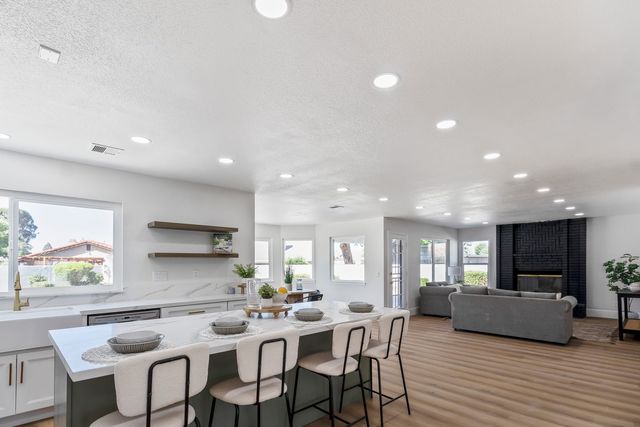
- Photographs and notes, room by room. Kitchen, baths, bedrooms, living areas and the garage are photographed. Finishes, flooring, windows and any updating are recorded.
- Condition observations. The water heater, electrical panel, heating and cooling equipment, roof covering and visible foundation are looked at, not tested. The condition rating, the appraiser's summary of the home's physical state, and the quality rating, a summary of how well it was built and finished, come from what is seen.
On a planned-village tract in Victoria or Terra Vista, where floor plans repeat, the visit usually runs to plan. What can stretch it is a change from the original plan: an enclosed patio, a converted garage, an added bath.
Why does a hillside home take longer?
Because a hillside house has more of everything to measure and more ground to cover. Split levels, decks, retaining walls and stairs to lower rooms each need measuring and photographing. Whether a lower level counts as gross living area depends on whether it sits above grade, and on a slope that can change from one wall to the next, so the appraiser walks the grade around the whole house.
The approach is part of the record too. The street, the driveway grade and how the lot sits against its neighbors are noted, because hillside access affects which buyers the house draws. View orientation is photographed, since a view is weighed against closed sales later, not described from the deck. Hillside stock in the coverage area includes Claraboya and Padua Hills in Claremont, Phillips Ranch in Pomona and the north Upland view homes. The hillside and custom home appraisal page covers how those homes are valued.
Why does a custom home take longer?
A custom home has no tract twin to lean on. In Alta Loma and along the Rancho Cucamonga foothills, custom and view homes sit beside older ranch houses on large lots, and no two are built alike. The appraiser cannot assume the layout from a neighboring sale, so every room is measured into the sketch and every material is recorded: the roofing, the windows, the millwork, the kitchen equipment.
That detail matters because quality drives the comparable search. A one-off house is compared with sales of similar quality and design across a wider area, and the report explains each one. The method is laid out in appraising a one-off house.
Why does a multi-family property take longer?
Every unit is seen and measured. A duplex is two inspections inside one visit, a fourplex is four, and the shared parts, laundry, parking and the lot, are recorded as well. The appraiser also compares what is on site with the legal unit count in permits and city records, because the number of legal units is often the first fact a lender or buyer needs. Fannie Mae's Selling Guide notes that the ANSI standard "cannot be used to measure apartment/multifamily buildings," so the measuring approach itself can differ by property type.
Occupied units add a scheduling step: the owner arranges entry and gives each tenant notice, explained in tenants in place. A unit that cannot be entered is stated in the report as a limit on the scope of work, the type and extent of research and analysis performed. The multi-family 2-4 unit appraisal page covers the income side.
Why do additions and second structures add time?
An addition is a second set of measurements and a permit question. The appraiser sketches where the original house ends and the addition begins, records how it was built and finished, and asks whether it was permitted, because permit history is how finished living area that counts is told apart from space that may not. An ADU, an accessory dwelling unit, is measured and sketched as its own structure, with its kitchen and bath recorded and its permit status confirmed.
Large lots work the same way. In Alta Loma and Etiwanda, horse-keeping lots can carry barns, arenas and other outbuildings, and each one is walked and photographed. Large parcels with several outbuildings take longer on site, and the timeline is confirmed before the engagement.
What does not change how long it takes?
Housekeeping. Clutter is not a value factor; condition is, and condition gets recorded either way. What keeps the visit to its time is access: unlocked side gates, secured pets, and a clear path to the attic hatch, the water heater, the electrical panel and the HVAC equipment. Permits, plans or a survey set out on a counter answer questions that would otherwise wait for the records search. How to prepare for a home appraisal has the full list.
None of that changes the value. It changes whether the appraiser can see everything in one visit.
How long until the report?
Reports are typically delivered three to five business days from the inspection. For lender work in Fannie Mae and Freddie Mac loans, the report format changed this month: the redesigned Uniform Residential Appraisal Report (URAR) is mandatory for reports submitted on or after November 2, 2026, and Freddie Mac lists the older 1004, 1073 and 1025 forms among those it replaces. The visit itself is the same; the lender's order states which format the report uses.
Next step
The scope call is where the inspection is sized: the property type, the lot, any additions or units, and who will provide access. See how an appraisal works here, then request an appraisal or call (909) 324-6122. The fee is set by the scope of the assignment and quoted before work begins, and it does not depend on the value. Rancho Cucamonga's pockets, from Victoria and Terra Vista to Alta Loma and Etiwanda, are described on the Rancho Cucamonga area page.
Sources
- Fannie Mae Selling Guide, B4-1.3-05, Improvements Section of the Appraisal Report (ANSI Z765-2021 measurement): https://selling-guide.fanniemae.com/sel/b4-1.3-05/improvements-section-appraisal-report (accessed November 6, 2026)
- Freddie Mac, Uniform Appraisal Dataset (UAD) 3.6 and Forms Redesign FAQ: https://sf.freddiemac.com/faqs/uad-and-forms-redesign (accessed November 6, 2026)
- The Appraisal Foundation, Uniform Standards of Professional Appraisal Practice (USPAP), 2024 edition: https://appraisalfoundation.org/imis/TAF/Standards/Appraisal_Standards/Uniform_Standards_of_Professional_Appraisal_Practice/TAF/USPAP.aspx (accessed November 6, 2026)
- California Bureau of Real Estate Appraisers, license lookup for Gordon Hall, BREA No. AR003877: https://www2.brea.ca.gov/breasearch/faces/party/view.xhtml?id=23601 (accessed November 6, 2026)
Gordon Hall, California Certified Residential Real Estate Appraiser, BREA No. AR003877 (lookup: https://www2.brea.ca.gov/breasearch/faces/party/view.xhtml?id=23601). Reports are prepared in conformity with the Uniform Standards of Professional Appraisal Practice (USPAP). Nothing here is legal or tax advice; admissibility is always the court's decision.
Frequently asked questions
How long does an appraisal inspection take?
30 to 60 minutes for a standard single-family home, longer for hillside, custom, multi-family or homes with additions. The time goes to measuring the exterior, photographing each room and recording condition.
Why does a hillside home take longer to inspect?
Split levels, decks, retaining walls and stairs to lower rooms each need measuring and photographing, and the appraiser walks the grade around the house to see which levels sit above grade. The approach road, driveway grade and view orientation are recorded as well.
Does cleaning the house make the inspection faster or change the value?
Neither. Clutter is not a value factor; condition is. What keeps the visit to its time is access: unlocked gates, secured pets and a clear path to the attic hatch, water heater, electrical panel and HVAC equipment.
How soon after the inspection is the report delivered?
Reports are typically delivered three to five business days from the inspection. Most of the work, the comparable research and the written analysis, happens after the appraiser leaves the house.